

Daniel Mateo
3 months ago


A Connecticut driver with a CDL often thinks the worst part of a DUI arrest is the court date. It isn't. The damage usually starts before the case is even filed, because one stop in a personal vehicle can threaten the commercial credential that pays the mortgage, feeds the family, and keeps the driver employable.
That's the trap. A dui with commercial driver's license case is not treated like a standard passenger-car DUI, and the system doesn't wait for a conviction to start punishing the driver. The criminal court, the DMV, the employer, and the federal compliance system can all move at once, and each one can create a different kind of problem.
A CDL holder who gets stopped on the way home from dinner in a pickup truck is not facing an ordinary DUI track. The officer sees a broken taillight, notices alcohol, and the case instantly splits into two realities, one criminal, one professional. The driver may still be fighting over the arrest in court months later, but the commercial license can already be under federal pressure.
That matters because FMCSA treats CDL holders as safety-sensitive drivers all the time, not just when they are on the clock. Under the federal framework, the key issue is whether the person is operating a commercial motor vehicle with alcohol in the system at or above the legal threshold, and that threshold is lower than the one most non-commercial drivers face. Federal guidance makes clear that a conviction tied to CMV operation can trigger disqualification sanctions even when the underlying conduct happened off duty while operating a commercial vehicle (FMCSA CDL state guidance, FMCSA disqualification rule).
The practical point is brutal. A CDL is not just a license, it's a livelihood credential. Once the arrest happens, the driver is no longer only defending against a charge, the driver is also trying to preserve employability.
Practical rule: The criminal case and the CDL consequences do not move in lockstep. A driver can still be damaged professionally before the court ever resolves anything.
That's why every choice after the stop matters. Whether the driver speaks, submits, refuses, asks for counsel, or lets deadlines pass can affect the commercial credential long before the final court outcome. In this setting, delay is dangerous.
A CDL holder behind the wheel of a commercial motor vehicle is held to a 0.04% BAC standard, and that threshold sits well below the one that applies in ordinary passenger-vehicle cases (49 U.S.C. text, Cornell CFR text). That lower line is the core of federal CDL alcohol enforcement.
Commercial driving is treated as a higher-risk job because the vehicle is larger, heavier, and capable of causing more harm. Federal law reflects that reality with a lower BAC ceiling and tougher consequences. The point is safety control, plain and simple.
CDL holders also make a costly mistake when they assume the rule only applies on duty or only in a tractor-trailer. Federal guidance says the disqualification can attach when a driver operates a commercial motor vehicle, even if the conduct happens off duty, so long as the CMV itself is involved (FMCSA off-duty CMV guidance).
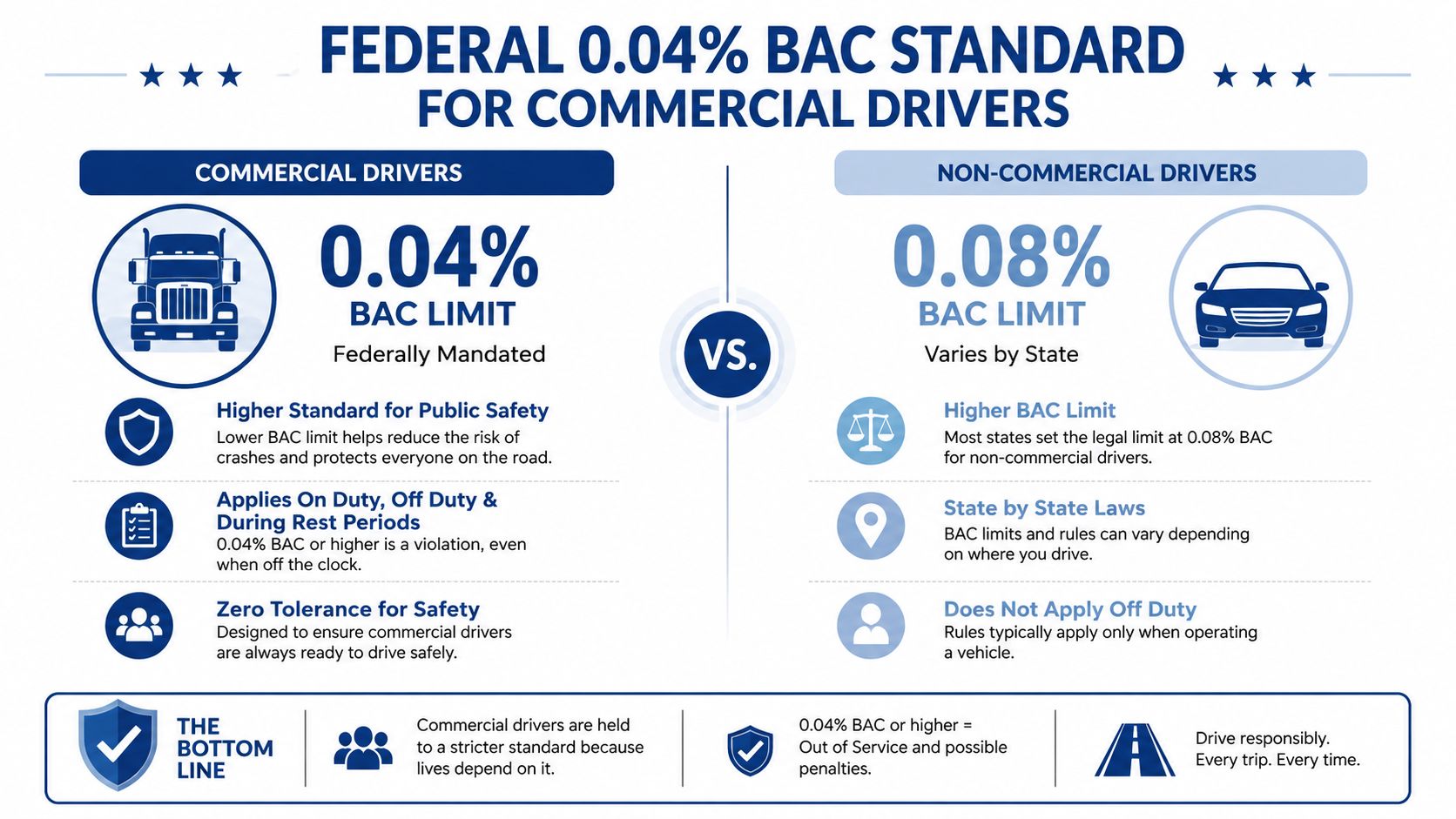
Refusing a required alcohol test does not avoid the CDL problem, it creates one (Cornell CFR text). CDL materials also describe an immediate roadside response, including being placed out of service for 24 hours when alcohol is detected at or above the CMV threshold or when the driver refuses the required test (South Dakota CDL handbook guidance, commercial driver DUI guidance).
That removal from service is separate from the criminal case. It is a safety action, and it can happen before the court sorts out anything.
A driver can lose work status fast, then face the licensing fallout, then face employer reporting and hiring consequences. That is the part many CDL guides miss. A low BAC reading is not minor for a commercial driver.
A DUI involving a CDL holder changes the job risk immediately. A passenger-license case can still bring Connecticut penalties, but the commercial driver is exposed to federal disqualification rules that can end CMV work even before the criminal case is resolved.
| Penalty Category | Standard Driver (Class D) | CDL Holder |
|---|---|---|
| BAC standard | Typically 0.08% in ordinary driving cases | 0.04% while operating a CMV |
| First offense impact | Criminal and DMV penalties under state law | At least 1-year CDL disqualification |
| Hazardous materials | Not a CDL-specific issue | 3-year minimum disqualification if placarded hazardous materials were involved (FMCSA safety planner) |
| Second offense impact | Longer state suspension, eventual restoration | Lifetime CDL disqualification |
| Work impact | May still be able to drive after reinstatement | Commercial work can stop immediately |
| Diversion or plea fallout | Often helps reduce the criminal record | Can still trigger CDL consequences and reporting |
A standard driver may be able to negotiate a case down to a lesser traffic offense and reduce the long-term damage. CDL holders do not get that same cushion. The federal side can still treat the event as disqualifying or reportable even when the criminal court offers a cleaner outcome. That is why a plea that looks good in a passenger case can still leave the commercial credential in trouble.
The employment fallout matters just as much as the courtroom result. A driver can avoid a criminal conviction and still lose access to DOT-regulated work. For a clearer view of how state convictions create licensing problems, see this discussion of convictions in Connecticut. A CDL case also needs a compliance mindset, the kind reflected in Fleetalyse operator licence insights, where process failures create their own penalties.

A CDL DUI arrest starts two fights at once. The DMV hearing runs on its own timetable, and the driver has to act fast or lose the chance to challenge the license action. The hearing request window is 45 days from receipt of the suspension notice. At that hearing, the questions are narrow, mainly probable cause, whether the person was operating, and whether the test result or refusal supports the state action. For a Connecticut breakdown of the process, see this Connecticut motor vehicle offenses overview.
That separation catches drivers off guard. The court case may move one way, while the DMV moves another way on a different record and a different standard. A criminal dismissal does not erase administrative consequences if nobody challenged the DMV case correctly.
Employer notice creates a second layer of risk. Under 49 CFR 383.31, a CDL holder must tell the employer about a traffic conviction within 30 days, and must report a suspension, revocation, or disqualification within one business day. That duty applies whether the stop happened in a truck or in a personal car. The reporting obligation follows the credential.
Miss the notice requirement and you create another federal problem on top of the arrest. Employers in regulated work do not treat that failure lightly, and neither will the agencies that review it. Treat every deadline as real.
A driver who wants to protect commercial work needs a lawyer who handles the DMV file, the criminal case, and the employment fallout together. The people at The Law Offices of Attorney Angel Lugo understand how Connecticut license actions spill into CDL employment problems, and that matters when your livelihood is on the line.
A positive alcohol test, a refusal, or a reportable conviction goes into a federal compliance record that follows the driver. The FMCSA Drug & Alcohol Clearinghouse is the database employers and regulators use to track that information, and it turns a local arrest into a hiring problem that can reach beyond Connecticut.
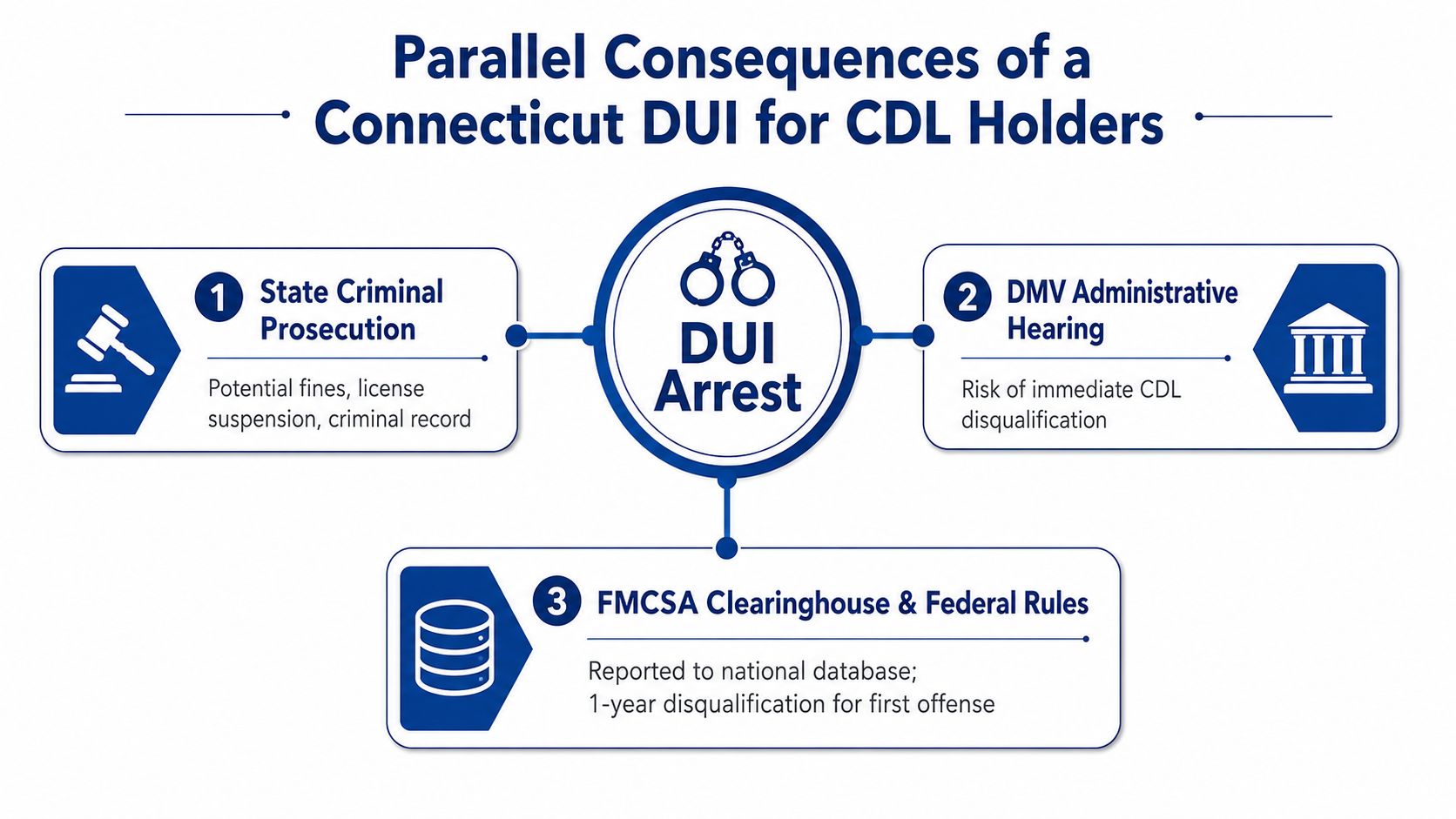
A CDL driver facing a DUI is dealing with three separate systems. The criminal court decides guilt and punishment. The DMV handles licensing consequences. The Clearinghouse determines whether the driver can realistically get back into DOT-regulated work.
That third track is where many drivers get blindsided. A reportable conviction, a refusal, or a positive alcohol test can stay visible to future regulated employers even after the court case ends. A resolved criminal case does not automatically clear the employment problem.
The return-to-duty process is specific. The driver must be evaluated by a DOT-qualified substance abuse professional, complete the required education or treatment, take a negative return-to-duty test, and then finish unannounced follow-up testing for up to 5 years. See the FMCSA Clearinghouse for the federal framework.
That process is the gate back into regulated work. Beating the criminal charge does not restore a CDL job if the federal compliance record still blocks hiring. Drivers lose time and opportunities when they focus only on the court file and ignore the Clearinghouse.
The right move is blunt. Treat the federal record as a separate case, because employers will.
A driver trying to protect commercial work needs counsel who handles the DMV case, the criminal case, and the employment fallout together. The people at The Law Offices of Attorney Angel Lugo understand how Connecticut license actions spill into CDL employment problems, and that matters when your livelihood is on the line.
The defense has to attack both the arrest and the fallout. A CDL holder who waits for the criminal court to sort itself out is already behind. The right strategy starts with the stop, then moves to the testing process, then to the licensing and employment consequences.
If the officer lacked reasonable suspicion for the stop, everything that followed can be vulnerable. That includes the field sobriety exercises and the chemical evidence. When the stop itself is weak, the case can start collapsing quickly.
The next target is the test process. Breath testing is only as good as the calibration records, the operator's certification, and the required observation period. A sloppy test is not reliable evidence, and a good defense lawyer should force the state to prove the machine and the procedure were both sound.
Key move: challenge the foundation, not just the result. A bad stop or bad test can be more valuable to attack than the final BAC number.
A lesser charge can matter a great deal for a CDL holder if it removes the case from the federal disqualification trap. That's why a reduction to a non-DUI traffic offense should be pushed hard when the facts support it. The criminal label often matters just as much as the punishment.
The internal resource on questions to ask a criminal defense attorney fits this point because the lawyer handling a CDL case should be able to explain the DMV, court, and employment consequences in one plan, not as separate surprises.
The DMV hearing is not a side issue. It's a parallel battleground with its own deadlines and pressure points. Requesting discovery early, preserving evidence, and challenging the hearing record can sometimes protect the commercial credential even while the criminal case continues.
That's where coordinated representation matters. The Law Offices of Attorney Angel Lugo handles Connecticut criminal defense and DUI matters, including license-preservation issues tied to motor vehicle offenses. In a CDL case, that kind of focused representation is useful because the defense has to account for the court file, the DMV file, and the job-risk file at the same time.
A commercial driver should not assume there's only one path to salvation. There are often several defenses, but they have to be pursued in the right order and without delay. Miss the timing, and the best arguments become meaningless.
The first myth is that a DUI in a personal vehicle doesn't affect a CDL. That's flatly wrong. Federal rules treat alcohol-related driving conduct as CDL-disqualifying when the conviction or refusal fits the commercial-driver framework, and the disqualification can attach even when the arrest happened outside a work truck context (FMCSA state guidance, FMCSA disqualification rule).
The second myth is that diversion or deferred prosecution is a safe escape. For CDL purposes, it often isn't. Recent state guidance explains that deferred prosecution can still count as a DUI conviction for CDL consequences, which means the driver may still face disqualification even if the criminal result looks softer on paper.
The third myth is that refusing the breath test buys time. It doesn't. Federal CDL rules treat refusal as disqualifying, and the sanction can be just as serious as a failed test (Cornell CFR text). Refusal is not a clean exit, it's another trigger.
The fourth myth is that hiring a criminal lawyer is enough. It isn't. A CDL case also involves DMV timing, employer notice, and the federal compliance record. Anyone who treats this like a standard DUI is underestimating the damage.
The clean takeaway is simple. A DUI with a CDL is not one problem. It's a stack of problems, and each one has its own deadline, rulebook, and consequence. The driver who acts fast has options. The driver who waits usually doesn't.
The Law Offices of Attorney Angel Lugo helps Connecticut drivers respond to DUI charges, DMV deadlines, and motor vehicle consequences that can threaten a commercial license. For a dui with commercial driver's license case, the firm can assess the criminal file and the licensing fallout together, then move on the deadlines that matter most. Visit The Law Offices of Attorney Angel Lugo to get a focused defense plan started before the next notice, hearing date, or employer deadline closes off your options.


Mon-Sat: 8:00am-5:00pm
Sunday: 9:00am-7:00 pm


Mon-Sat: 8:00am-5:00pm
Sunday: 9:00am-7:00 pm


