

Daniel Mateo
4 months ago


A court notice turns up under a stack of mail, and the hearing date has already passed. Or a driver checks a pending case and discovers that a routine appearance was yesterday. The immediate concern is arrest, but the missed date may also affect the bond and create a separate criminal charge.
For someone searching for “failure to appear CT,” the safest starting point isn't an explanation to police or an unplanned courthouse visit. It's identifying the order the judge entered, preserving evidence of what happened, and arranging the next action with counsel.
A failure-to-appear warrant is a judicial order authorizing law enforcement to arrest someone the state believes missed a scheduled hearing; the Connecticut Judicial Branch includes criminal cases, motor-vehicle cases, and infractions within that definition. An FTA warrant therefore isn't limited to a serious felony prosecution.
The distinction matters because a person may consider the original matter minor and assume a missed appearance only produces another notice. A warrant is arrest authorization, not an administrative reminder. Once issued, it can add another stage of court involvement beyond the hearing that was missed.
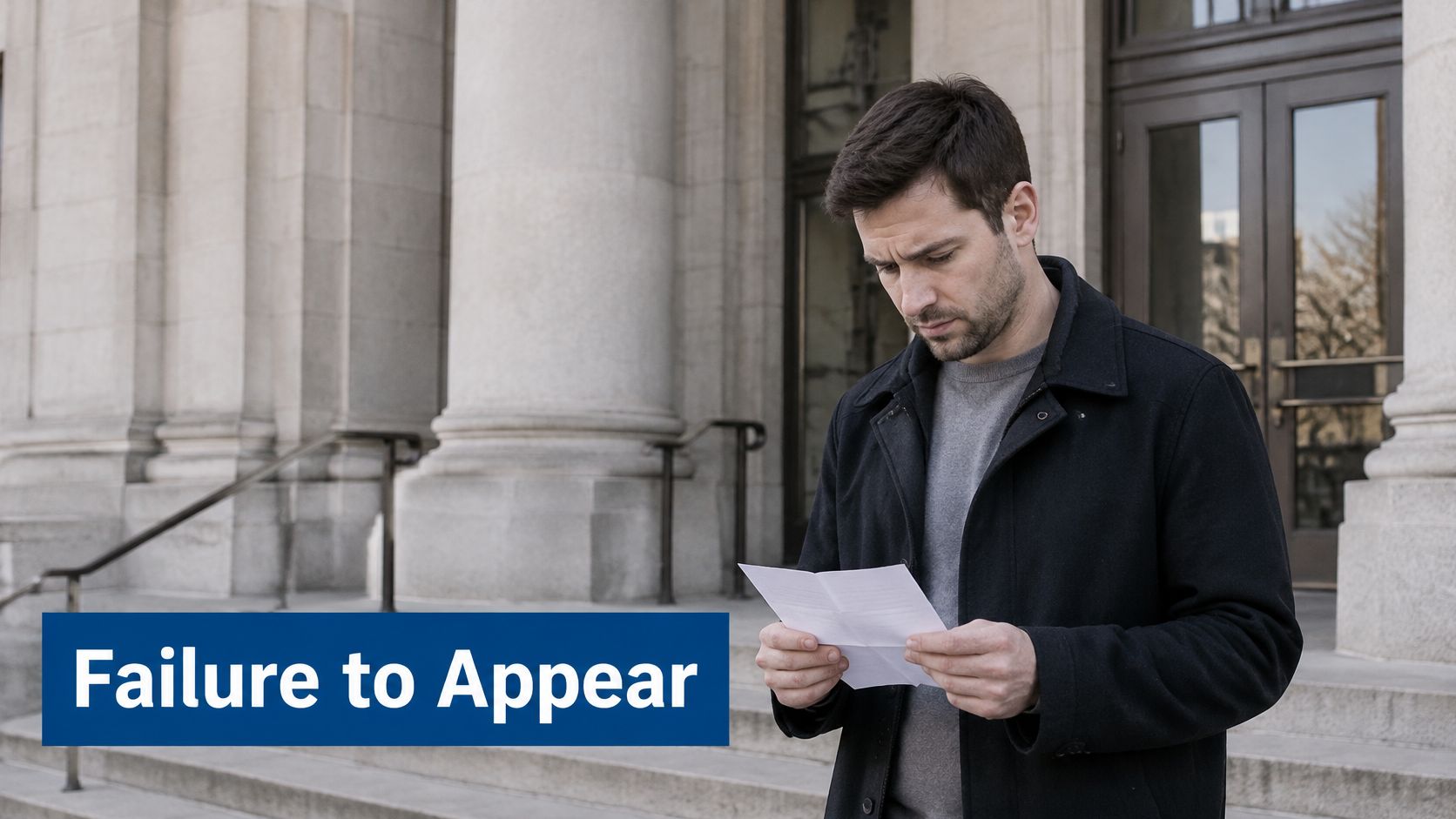
A warrant works like a flag in a database. If the court issues it after a missed date, the flag stays raised until the proper authority clears it. The hearing passing doesn't mean the problem has ended.
That analogy has an important limit: not every missed appearance automatically produces a warrant. The court's actual order controls. A defendant shouldn't assume that a warrant exists, but shouldn't assume that silence means nothing happened either.
An explanation for missing court and an order clearing a warrant are different things. Only the court process can resolve the warrant.
The original allegation remains its own matter. A person contesting a motor-vehicle charge, for example, still needs to address that case even after resolving the missed appearance.
A separate FTA charge raises another question: whether the absence was willful. An emergency, disputed notice, or other circumstances can matter to that analysis, but an explanation doesn't erase an arrest-authorizing order by itself.
The practical questions are therefore distinct. What did the judge order after the absence? What must happen to address the warrant, release conditions, and any new charge? Keeping those questions separate prevents a common mistake: treating a new court date as proof that every consequence has disappeared.
Consequences of a missed court date in Connecticut
| Situation | Classification | Immediate response | Main exposure |
|---|---|---|---|
| Missed felony case hearing while released | First-degree FTA, class D felony if statutory requirements, including willfulness, are met | Rearrest warrant or capias may issue | New felony charge alongside the original case |
| Missed misdemeanor or qualifying motor-vehicle hearing | Second-degree FTA, class A misdemeanor if statutory requirements are met | Rearrest warrant or capias may issue | New misdemeanor charge and possible arrest during a traffic stop |
| Missed criminal, motor-vehicle or infraction hearing | FTA warrant as defined by the Judicial Branch | Arrest authorization entered into the statewide system if issued | Enforcement record that outlasts the hearing |
| Bond of $500 or more forfeited for nonappearance | Bond forfeiture under Conn. Gen. Stat. § 54-65a | Rearrest warrant, surety notified, six-month stay on execution | Surety liability and an active warrant |
| Judge directs a Bail Commissioner's Letter | Written notice setting a new court date | New appearance date | Another missed date can create further FTA exposure |
| Missed remote video or phone hearing | Treated like an in-person miss | Rearrest warrant may issue | Additional Failure to Appear charge |
| Juvenile summons date missed | Take-into-custody order or arrest warrant may issue | Police may locate the child and bring the child before a judge | Detention and separate court proceedings |
Under the Connecticut criminal-procedure statutes, willfully missing a required appearance while charged with a felony, or while on felony probation for a violation-related hearing, can constitute first-degree FTA, a class D felony; willfully missing while charged with a misdemeanor or qualifying motor-vehicle offense can constitute second-degree FTA, a class A misdemeanor. The same statutory compilation provides reference imprisonment maximums of up to five years for a class D felony and up to one year for a class A misdemeanor.
These figures are statutory maximums; the sentence in any given case depends on its facts, and the prosecution bears the burden of establishing the applicable offense.
An FTA allegation arrives alongside the original case, so the two proceed on parallel tracks until each is resolved. A probation-related hearing also requires attention to the underlying violation-of-probation proceedings in Connecticut, since the missed date and the alleged violation move through court separately.
Circumstances such as notice problems, calendaring errors, transportation failures, hospitalization or custody in another jurisdiction can bear on what the prosecution must prove, so the first step is documentary. Counsel should examine:
The table lists potential consequences, and each one runs on its own clock. The warrant governs custody risk, the forfeiture governs money, and the new charge adds a separate prosecution. The court's actual order determines which of those clocks are ticking and which issues need resolution first.
An arrest warrant and a forfeited bond run on different clocks. The warrant creates an immediate custody risk. The bond creates a financial issue involving the defendant, a surety, or an insurer.
Resolving one doesn't necessarily resolve the other. A defendant's return to court should therefore prompt a review of both records, not just a request for another hearing date.
Connecticut implemented the Paperless Arrest Warrant Network after Public Act 00-209 authorized central entry of FTA warrants; the Judicial Branch's warrant-system explanation describes immediate transmission from the Criminal Motor Vehicle System to make warrant information available statewide. An unresolved warrant isn't confined to the courthouse where the original case began.
Say a driver is stopped for a broken taillight. The officer checks the driver's information and finds an active warrant from a missed hearing elsewhere in Connecticut. The driver's belief that the original matter was minor doesn't prevent the officer from acting on the warrant.
The practical task is to establish what was issued: a letter, a warrant, or a capias. A remembered conversation or an expectation of another notice isn't a substitute for the actual court entry.
When a court forfeits a bond of $500 or more for nonappearance, Conn. Gen. Stat. § 54-65a requires a rearrest warrant or capias, notice to the surety or insurer, and a six-month stay on execution of the forfeiture, but that stay doesn't prevent immediate issuance of the warrant.
The stay concerns collection of the forfeiture. It isn't permission for the defendant to remain absent, and it doesn't suspend police authority to execute an active warrant.
For Spanish-speaking readers, bond is commonly called fianza. In a surety arrangement, the surety provides the financial guarantee securing the defendant's return to court; the bond amount shouldn't be confused with a fee paid to obtain that guarantee.
Practical rule: Treat the warrant record and the bond record as separate items requiring separate confirmation.
Counsel should identify the surety, obtain any forfeiture notice, and determine what relief must be requested. A planned appearance can address personal release conditions while also allowing counsel to raise the bond issue.
The judge may have directed a Bail Commissioner's Letter instead of an immediate arrest response. That possibility makes verification urgent, not optional: the correct next action depends on the order entered.
Justifications for a missed date and the proof each needs
| Justification | Evidence to gather | Typical weight |
|---|---|---|
| Never received the notice | Mailing address on file, returned-mail records, proof of any address change | Can support a challenge to willfulness when notice is disputed |
| Hospitalization or medical emergency | Admission or discharge records dated the hearing day | Strong when the records are specific and dated |
| Held in custody elsewhere | Custody or booking record covering the hearing date | Strong evidence of inability to attend |
| Transportation failure | Documented transit disruption or vehicle breakdown, with timing | Weaker; judged case by case |
| Court or attorney calendar error | Notice record or docket showing a different date | Can shift responsibility away from the defendant |
| Forgot the date | Any available surrounding communications or calendar records | Rarely sufficient alone; a prompt, controlled appearance matters |
A person may have forgotten the hearing. That doesn't mean the court will accept forgetfulness as a sufficient answer to the charge or the warrant. Counsel needs the surrounding facts, including how the person learned of the date and what happened after discovering the mistake.
Transportation explanations also need detail. “The car wouldn't start” leaves unanswered whether the problem arose before the hearing, whether another route was available, and whether anyone contacted counsel or the court.
Useful records include a tow receipt, a repair intake record, or a dated transit alert. The purpose isn't to assemble a dramatic story. It's to establish a reliable timeline that addresses why attendance didn't occur.
A hospital discharge record tied to the hearing day is more useful than a statement that the defendant had been feeling unwell. Medical records should establish the relevant timing and functional problem without disclosing unrelated sensitive information unnecessarily.
For example, a defendant admitted to a hospital on the morning of a Hartford hearing could gather the admission record, the docket identifying the hearing, and a short chronology of when the emergency began. Counsel can then assess what documentation should be submitted and how.
Notice disputes require similar care:
A defendant who was incarcerated elsewhere should obtain records covering the relevant appearance date. Counsel can investigate whether the courts knew about that custody and whether arrangements were made for attendance.
Evidence supports an argument; it doesn't guarantee recall of a warrant or dismissal of an FTA charge.
Collecting records promptly helps preserve details that can become difficult to reconstruct. No document should be altered, backdated, or supplemented with an invented explanation.
The Connecticut Judicial Branch's bail guidance explains that a judge may order an FTA arrest warrant or direct a Bail Commissioner's Letter setting another date, and advises contacting an attorney or the court to learn what action is required. There isn't a single automatic remedy for every missed hearing.
The immediate workflow starts with the record, not an assumption about what usually happens.

Check the case status. Review the Connecticut Judicial Branch online case lookup or contact the clerk for the court handling the case. Identify any warrant, capias, Bail Commissioner's Letter, or new date. An unclear online entry should be confirmed rather than interpreted as clearance.
Record the case type and release conditions. Gather the original charges and the written conditions governing release. A promise to appear, bond paperwork, and probation-related orders can contain obligations that aren't obvious from a short docket entry.
Collect the explanation and supporting records. Assemble the notice, medical documents, custody records, transportation evidence, or conflicting calendar information. Keep originals and create readable copies. A brief chronology should distinguish confirmed facts from details that still need checking.
Speak with criminal defense counsel before appearing anywhere. Counsel can review the actual order, evaluate available requests, and explain the possibility of custody. If arrest is likely, understanding what happens after an arrest helps the defendant prepare without assuming release is guaranteed.
Plan the appearance or surrender. Counsel should determine the appropriate location and procedure with the relevant court or agency. A controlled arrangement means preparation and coordination, not immunity from arrest or a promise of immediate release.
Request the necessary court relief. Counsel can assess whether to seek recall of the warrant, another appearance date, or other appropriate relief. The bond and surety record should be addressed at the same time so that an unresolved financial issue isn't overlooked.
Attend and confirm the resulting orders. The defendant should bring the required documents and follow the judge's instructions. Afterward, counsel should verify what happened to the warrant, whether release conditions changed, and what remains pending in the original case or any FTA prosecution.
Keep the paperwork and recheck the docket. Preserve orders, receipts, and the next hearing notice together. A follow-up check about a week later can help identify an uncorrected entry, but any uncertainty about an active warrant calls for immediate clarification rather than waiting.
This order preserves options before an unexpected arrest limits preparation. It also gives counsel a coherent record instead of scattered explanations delivered after the defendant is already in custody.
A phone call alone doesn't establish that a warrant has been recalled. The defendant needs confirmation of the court's action and must continue following every existing deadline unless the court changes it.
Statewide law governs missed appearances in Hartford, New Britain, New Haven, and Bridgeport. Each courthouse nevertheless has its own session schedule, courtroom assignments, and clerk procedures. The notice, docket, and current court instructions control the particular appearance.
Hartford, New Britain, and New Haven have judicial districts bearing those names. Bridgeport is within the Fairfield Judicial District. A judicial-district name alone may not identify the correct building or session, so the full court location matters.
A person addressing an FTA should confirm the practical details before traveling:
Moving to another Connecticut city doesn't transfer a case automatically. A defendant living in New Haven may still need to address an order entered in Hartford, and the current address should be checked in the court record.
The Judicial Branch's remote-hearing instructions warn that failing to appear remotely at the scheduled date and time may lead to a rearrest warrant and an additional Failure to Appear charge. Joining by telephone or video doesn't make attendance optional.
The participant should test the connection, confirm the access instructions, and have the case number available. A calendar entry should identify both the time and the method of attendance.
If a connection fails, the participant should preserve the error message and promptly contact counsel or the designated court contact. Repeatedly trying the same broken connection without notifying anyone may leave no clear record of the attempted attendance.
The warrant record may originate in the court where the case started even when the defendant now lives elsewhere. The correct response is coordinated with that court, not selected solely for convenience.
An active warrant calls for prompt legal advice. The same is true of felony-level FTA exposure, a bond forfeiture or surety notice, a prior missed appearance, a missed remote hearing, or uncertainty about whether the court issued a letter, warrant, or capias.
Waiting until police contact occurs leaves less time to gather records and prepare a release argument. Counsel can separate the immediate custody issue from the underlying case and any disputed claim of willfulness.
Court notices often combine legal terminology with practical instructions. A bilingual attorney can review documents in English and Spanish, explain available options, and help a client prepare for court without relying on an informal translation by a relative.
For someone seeking a Spanish-speaking lawyer, the important question is whether the person understands the current order, the potential consequences, and the next required action. Attorney Angel A. Lugo was admitted to the State of Connecticut Bar in 2010 and the District of Connecticut Bar in 2015.
The first call is more useful with:
The Law Offices of Attorney Angel Lugo offers free, confidential initial consultations to assess fit and next steps. The office can be reached by phone at 860-987-3090 or 203-500-3616, or by email at info@attorneyangellugo.com.
Information on this Hartford Attorney / Law Firm website is for general information purposes only. Nothing on this or associated pages, documents, comments, answers, emails, or other communications should be taken as legal advice for any individual case or situation. Each reader should verify the applicable docket and deadlines with a licensed attorney.
The Law Offices of Attorney Angel Lugo offers Connecticut criminal defense representation and bilingual English–Spanish support for people facing missed-appearance issues. For help assessing a warrant, bond concern, or possible FTA charge, visit The Law Offices of Attorney Angel Lugo to arrange a free initial consultation.


Mon-Sat: 8:00am-5:00pm
Sunday: 9:00am-7:00 pm


Mon-Sat: 8:00am-5:00pm
Sunday: 9:00am-7:00 pm


